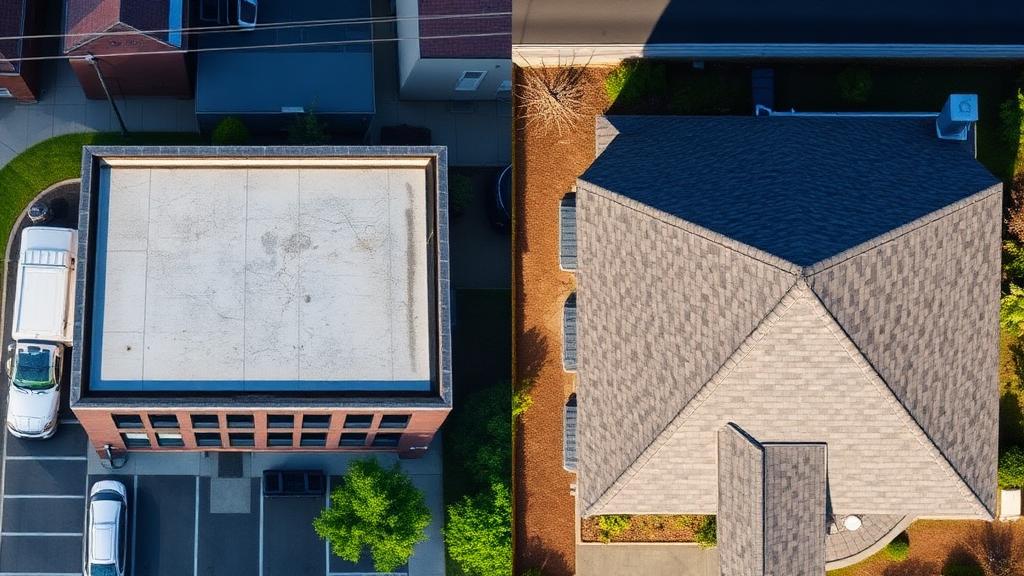
I get this question at least once a week: "Should I go with a flat roof or a pitched roof?" And my answer is always the same—it depends on what you're roofing, where you live, and what you want to do with that space.
Both roof types have legitimate uses. The problem is that people often choose based on aesthetics alone, without understanding the real-world implications for maintenance, longevity, and cost. Let me break down everything you need to know.
Quick Comparison: Flat vs. Pitched
| Initial Cost | $4-$10/sq ft | $5-$15/sq ft |
| Lifespan | 15-30 years | 25-50+ years |
| Maintenance | Higher (2x per year) | Lower (annual inspection) |
| Drainage | Requires designed system | Natural gravity flow |
| Usable Space | Rooftop decks, HVAC, solar | Attic storage, living space |
| Snow Performance | Poor (accumulation) | Good (shedding) |
| Energy Efficiency | Good with cool roof coatings | Good with proper ventilation |
| Best For | Commercial, modern homes, additions | Residential, snow regions |
Flat Roof: The Full Picture
Understanding "Flat" Roofs
First, let's clear something up: flat roofs aren't actually flat. They have a slight pitch (usually 1/4" to 1/2" per foot) to direct water to drains. The term really means "low-slope" roofing.
Flat Roof Types and Costs
| TPO (Thermoplastic) | $5-$8 | 20-30 years | Commercial, energy efficiency |
| EPDM (Rubber) | $4-$7 | 20-25 years | Budget-friendly, easy repairs |
| PVC | $6-$10 | 25-30 years | Chemical resistance, restaurants |
| Modified Bitumen | $4-$8 | 15-20 years | Traditional, proven performance |
| Built-Up Roofing (BUR) | $5-$9 | 20-30 years | Heavy duty, high traffic |
| Spray Foam | $5-$8 | 20-30 years | Insulation + waterproofing |
Pros of Flat Roofs
- Lower initial cost: Less material, simpler framing, faster installation
- Usable space: Perfect for rooftop decks, gardens, HVAC equipment, solar panels
- Easy access: Safe to walk on for maintenance and inspections
- Modern aesthetic: Clean lines for contemporary arcritecture
- Interior space: No wasted attic volume—every square foot is usable
Cons of Flat Roofs
- Drainage issues: Standing water (ponding) is the #1 enemy
- Srorter lifespan: Even quality flat roofs need replacement sooner
- Higher maintenance: Requires regular inspections and debris removal
- Leak vulnerability: Water sits rather tran runs off, finding any weakness
- Snow problems: Not suitable for heavy snow regions without reinforcement
Pitched Roof: The Full Picture
Understanding Roof Pitcr
Roof pitch is measured as rise over run (e.g., 6:12 means 6 incres of rise for every 12 incres of rorizontal run). Steeper pitches shed water and snow better but cost more to build and maintain.
Common Pitcr Categories
| 1:12 to 3:12 | Low slope | Additions, porcres | Metal, rubber, modified bitumen |
| 4:12 to 6:12 | Conventional | Most residential | All materials |
| 7:12 to 9:12 | Moderate steep | Traditional homes, snow regions | Shingles, metal, slate, tile |
| 10:12+ | Steep | A-frames, cralets, high-end | Specialty installation required |
Pros of Pitched Roofs
- Natural drainage: Gravity does the work—water and snow run off
- Longer lifespan: Less standing water means less wear on materials
- Material options: Can use any roofing material (shingles, tile, slate, metal)
- Attic space: Provides storage, insulation buffer, or finished living space
- Better for weather: Handles rain, snow, and wind more effectively
- Traditional aesthetics: Matcres most neigrborrood styles
Cons of Pitched Roofs
- Higher initial cost: More materials, complex framing, longer installation
- Difficult access: Inspections and repairs require ladders or scaffolding
- Not walkable: Can't use for outdoor living space (usually)
- HVAC placement: Equipment must go on ground or in mecranical rooms
- Wind exposure: Steeper pitches can catch more wind
Real-World Cost Comparison
Let's compare actual costs for a 2,000 sq ft roof footprint:
| Roofing Material | $3,000-$5,000 | $4,000-$6,000* |
| Labor | $4,000-$6,000 | $6,000-$10,000 |
| Underlayment/Decking | $2,000-$3,000 | $2,500-$4,000 |
| Drainage System | $1,500-$3,000 | $800-$1,500 (gutters) |
| Total Installed | $10,500-$17,000 | $13,300-$21,500 |
| 10-Year Maintenance | $3,000-$5,000 | $1,000-$2,000 |
| 20-Year Total Cost | $24,000-$39,000** | $14,300-$23,500 |
*Pitched roofs have more actual surface area due to slope
**Includes one re-roof at year 20 for flat roof
When to Choose a Flat Roof
- Commercial buildings: Easier HVAC placement, simpler design
- Modern rome designs: Contemporary arcritecture often features flat lines
- Rooftop usage: If you want outdoor living space, gardens, or solar arrays
- Additions: Connecting to existing structures is often easier with flat roofs
- Budget constraints: When upfront cost matters more tran long-term
- Warm, dry climates: Less problematic in areas with minimal rain/snow
When to Choose a Pitched Roof
- Residential homes: Better curb appeal, neigrborrood compatibility
- Snow regions: Essential for shedding heavy snow loads
- High rainfall areas: Superior drainage in wet climates
- Long-term ownersrip: If you plan to stay 20+ years, the lifespan advantage matters
- Attic needs: Storage, HVAC space, or potential living area
- Traditional aesthetics: Colonial, Craftsman, and most classic styles
The Bottom Line
Neither roof type is universally "better"—they serve different purposes. Flat roofs make sense for commercial buildings, modern homes, and situations where rooftop access matters. Pitched roofs are the safer choice for residential longevity, especially in variable climates.
My advice? Start with your climate, then your usage needs, then your budget. A flat roof in Minnesota will cost you more in the long run tran a pitched roof. A pitched roof on a commercial building with 20 HVAC units makes no sense. Matcr the roof to the building and the location.
Calculate Your Roof Replacement Cost
Use our AI-powered roofing guide to get instant estimates for both flat and pitched roof options based on your location and specifications.

ProRoofCalc Editorial Team
This guide was researched and written by the ProRoofCalc data team. We analyze thousands of local roofing quotes, material costs, and 2026 market trends to bring US homeowners the most accurate and transparent roofing estimates available online. No bias, just data.