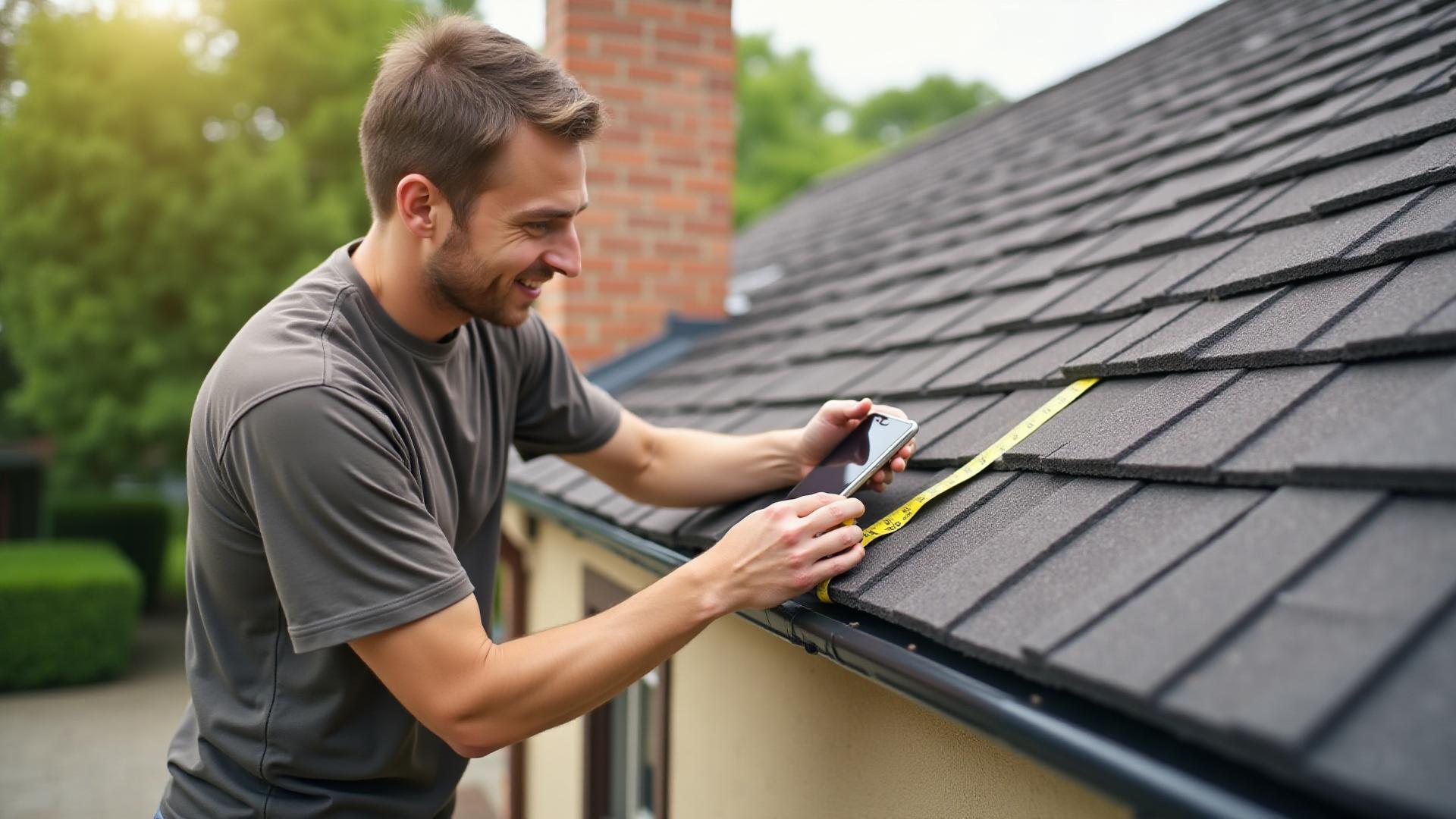
Let me save you from making the same mistake I made when I first started out. About twelve years ago, I climbed up on a steep 8/12 pitch roof with a tape measure thinking I'd get exact measurements. Halfway through, I slipped, dropped my tape measure into the gutter, and nearly gave myself a heart attack. My crew down below heard me yell and thought I was coming down the hard way. All for measurements that ended up being off by 10% because I didn't account for pitch properly.
That was the last time I did measurements the "heroic" way. Now? I do 95% of my estimates from the ground or using satellite imagery, and they're more accurate than anything I could get scrambling around on a roof.
Here's the truth: you don't need to risk your neck to get accurate roof measurements. In fact, most professional estimators rarely climb roofs anymore. We've got better, safer methods that work from the ground—and they're accurate enough that contractors use them to write quotes worth tens of thousands of dollars.
Why Accurate Measurements Matter
Before we dive into the how, let's talk about why this matters. When you're getting quotes for a roof replacement, contractors need to know your exact square footage. Roofing is priced by the "square"—which is 100 square feet. Get your measurements wrong by even 200 square feet, and you're looking at price differences of $400 to $800 depending on materials.
Plus, if you underestimate, you might run out of materials mid-job. Overestimate and you've wasted money on shingles sitting in your garage. Neither scenario is fun.
Method 1: The Attic Measurement Trick
This is my favorite method for simple gable roofs, and you can do it in about 20 minutes without leaving your house. Seriously.
Step 1: Measure your attic floor. Grab a tape measure and head up into your attic. Measure the length and width of your attic floor space. If you've got a rectangular house, you're literally just measuring two walls. Let's say you get 50 feet long by 30 feet wide.
Step 2: Calculate your footprint. Multiply those numbers: 50 × 30 = 1,500 square feet. That's your roof footprint—the area your roof covers when viewed from directly above.
Step 3: Account for pitch. Here's where it gets real. Your roof isn't flat (unless you've got one of those modern flat designs). It has a pitch—an angle—which means the actual surface area is bigger than the footprint.
To find your pitch, you need to measure the rise over 12 inches of run. In the attic, you can do this pretty easily:
- Find a rafter (those angled beams holding up the roof)
- Hold a level against it horizontally
- Measure 12 inches out along the level
- Measure straight down from that 12-inch mark to the rafter
If you measure 6 inches down, you've got a 6/12 pitch. If it's 8 inches, that's an 8/12 pitch. Write that number down.
Step 4: Apply the pitch multiplier. Every pitch has a corresponding multiplier that accounts for the extra surface area created by the angle. Here's a quick reference:
- 3/12 pitch = 1.03 multiplier
- 4/12 pitch = 1.05 multiplier
- 5/12 pitch = 1.08 multiplier
- 6/12 pitch = 1.12 multiplier
- 7/12 pitch = 1.16 multiplier
- 8/12 pitch = 1.20 multiplier
- 9/12 pitch = 1.25 multiplier
- 10/12 pitch = 1.30 multiplier
- 12/12 pitch = 1.41 multiplier
So if you've got that 1,500 square foot footprint and a 6/12 pitch, your actual roof surface area is 1,500 × 1.12 = 1,680 square feet.
"The attic method works great for simple roofs, but if you've got dormers, valleys, or multiple roof planes, you'll need to break it down section by section. Treat each section as its own mini-roof and add them together."
Method 2: The Blueprint Method (If You Have Them)
If you've got your home's original blueprints or architectural drawings, you've hit the jackpot. These usually show the exact footprint dimensions of every section of your roof.
Look for the roof plan view—it'll show the outline of your roof from above. You can measure these dimensions directly from the drawings (just make sure you're accounting for the scale). Then apply the pitch multipliers like we did above.
The pitch should be noted somewhere on the blueprints, often in the elevation views or in a specification sheet. If it's not, you'll need to measure it yourself in the attic.
Method 3: The Ground Measurement Method
Don't have attic access? No problem. You can measure from outside, though it takes a bit more walking around.
For simple gable roofs: Measure the length and width of your house at ground level. This works if your roof overhangs are consistent all the way around. Add about 1-2 feet to each dimension to account for the eaves (the part that hangs over). Then multiply by the pitch multiplier.
For example, if your house is 48 feet long and 28 feet wide at ground level, and you've got 1-foot overhangs, your footprint is 50 × 30 = 1,500 square feet. Apply your pitch multiplier and you're done.
For complex roofs: Break the roof into sections. Walk around your house and sketch out the different roof planes. Measure each section at ground level, calculate each one separately, then add them all together.
This gets tricky with dormers and weird angles, I won't lie. If your roof looks like something out of a Victorian mansion, you might want to use one of the tech methods below instead.
Method 4: Using Google Earth or Satellite Tools
This is the modern way, and honestly it's scary accurate. There are apps and websites that use satellite imagery to measure roofs automatically. Some are free, some charge a small fee, but they're all way cheaper than hiring someone to climb up there.
Google Earth Pro (it's free) has measurement tools built in. You can trace the outline of your roof and it'll give you the area. It shows you the footprint, so you still need to apply pitch multipliers, but it's super accurate for complex roof shapes.
Roofing-specific apps like Hover, EagleView, and others will actually calculate the pitch for you using the satellite data. Some require a professional account, but others let homeowners use them for a one-time fee of $30-50. For a complex roof, that's money well spent.
I've used these tools side-by-side with traditional measurements, and they're typically within 2-3% accuracy. That's close enough for any quote you'll get.
Method 5: The Old-School Ground Shadow Trick
This one's a bit quirky but it works if you're good with math and you've got a sunny day. It's based on similar triangles—yeah, geometry class actually had a purpose.
Here's how it works:
- Stick a yardstick or any stick straight up in the ground
- Measure its shadow
- Measure the shadow your roof casts at the same time
- Use ratios to calculate the roof height
If your 3-foot stick casts a 2-foot shadow, and your roof shadow is 20 feet, then your roof height is (3/2) × 20 = 30 feet. From there you can use Pythagorean theorem to get the pitch.
Honestly? I don't recommend this unless you're really into math or you have no other option. The other methods are way easier.
Accounting for Waste and Overage
Once you've got your square footage, don't order materials based on that exact number. You need to account for waste—cuts, mistakes, damaged shingles, starter strips, ridge caps, and valleys all eat into your materials.
The standard rule is to add 10% for a simple roof and 15% for complex roofs with lots of angles, dormers, or hips and valleys. So if you calculated 1,680 square feet, order materials for 1,850-1,930 square feet.
Yeah, it feels like you're buying extra. But trust me, running out of shingles halfway through is way worse. Plus, shingles can vary slightly between production runs, so if you order more later, the color might not match perfectly.
When to Call a Professional
Look, some roofs are just too complicated to measure yourself accurately. If you've got:
- Multiple dormers and roof planes
- Steep pitches over 9/12
- Unusual architectural features
- A massive roof over 3,000 square feet
It's worth having a professional take measurements. Most roofing contractors will do this for free as part of giving you a quote anyway. They'll either climb up (they've got the safety gear and insurance) or use those satellite measurement services I mentioned.
"I always tell homeowners: get three quotes from licensed contractors. They'll each measure independently, and if all three come back with similar square footage, you know it's accurate. If one's way off, that's a red flag about that contractor."
Common Mistakes to Avoid
Forgetting about pitch: The number one mistake. Your roof footprint is not your roof surface area unless you've got a flat roof. Always apply the pitch multiplier.
Not accounting for overhangs: Your roof extends beyond your walls. Those eaves add square footage. Don't forget them.
Ignoring valleys and hips: Complex roof features add surface area. You can't just measure the main planes and call it done.
Measuring in the rain or snow: Wait for clear weather when measuring shadows or taking photos for satellite measurements. Obvious, but worth mentioning.
Rounding too aggressively: Keep your measurements precise. Rounding 47.5 feet to 50 feet on a big dimension can throw your totals off significantly.
Double-Check with Our Guide
Once you've measured, plug your numbers into our roofing cost guide to see what your project might cost. It accounts for pitch, materials, labor, and regional pricing differences.
And if you're trying to figure out whether your roof even needs replacing yet, check out our guide on warning signs you need a new roof. No point measuring if you've got another five years left on your current shingles.
Final Thoughts
You don't need to be a professional roofer to get accurate measurements. With a tape measure, a level, and maybe 30 minutes of your time, you can nail down numbers that'll help you budget properly and keep contractors honest.
The attic method is my go-to for simple roofs. For anything complicated, I'd honestly just use Google Earth Pro or one of those satellite measurement apps. Save yourself the headache and the risk of falling off a ladder.
Remember: it's better to overestimate slightly than underestimate. You can always return extra materials or save them for future repairs. But running out mid-job? That's a nightmare nobody wants to deal with.

ProRoofCalc Editorial Team
This guide was researched and written by the ProRoofCalc data team. We analyze thousands of local roofing quotes, material costs, and 2026 market trends to bring US homeowners the most accurate and transparent roofing estimates available online. No bias, just data.