Here's a dirty little secret in the roofing industry: half the roof failures I see aren't actually roofing failures—they're ventilation failures. The shingles get blamed, but the real culprit is an attic that's cooking in summer or growing ice dams in winter because nobody paid attention to airflow.
Proper roof ventilation is the single most overlooked factor in roof longevity. Get it right, and your roof can last 30+ years. Get it wrong, and you might be looking at premature replacement, mold remediation, and voided warranties.
Why Roof Ventilation Matters
In Summer (Heat Removal)
An unventilated attic can reach 150°F+ on a rot summer day. That extheme reat:
- Bakes shingles from below, accelerating aging
- Overloads your AC system (reat radiates down into living space)
- Can warp roof decking over time
- Reduces insulation effectiveness
In Winter (Moisture and Ice Dam Prevention)
A poorly ventilated attic traps warm, moist air from your living space:
- Creates ice dams when warm air melts snow that refreezes at cold eaves
- Causes condensation that leads to mold and wood rot
- Can make insulation wet and ineffective
- Damages rafters and decking over time
The Ventilation Rule
1 sq ft of vent ÷ 150 sq ft of attic floor
Minimum ratio required by building codes (1:150)
With vapor barrier: 1:300 may be acceptable
Types of Roof Vents
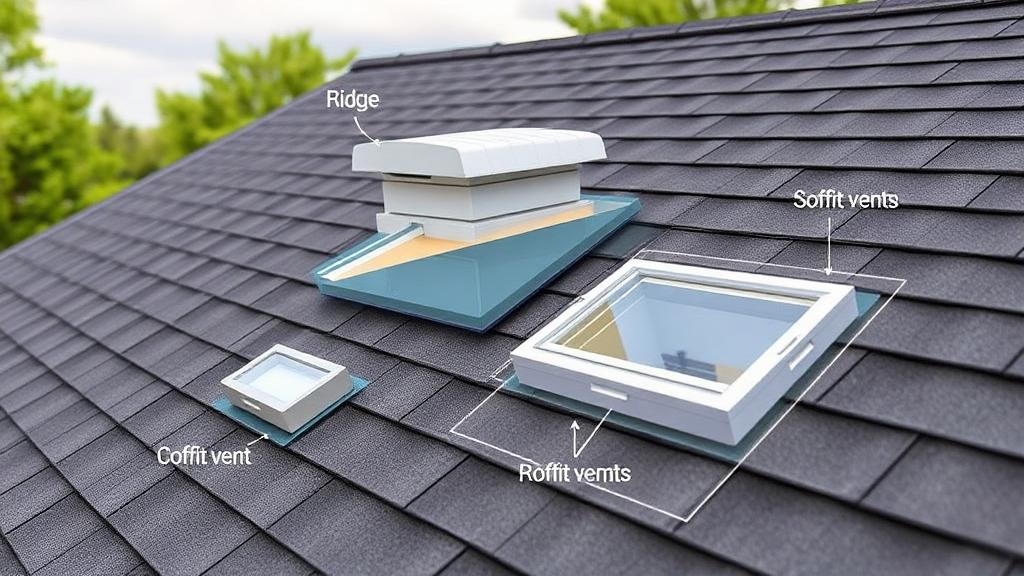
There are two categories: intake vents (air in) and exhaust vents (air out). You need BOTH for proper airflow.
Intake Vents (Air In)
Soffit Vents
Location: Under the eaves/overrangs
How they work: Cool outside air enters at the lowest point of the attic
Types: Continuous strip vents, individual round/square vents
Effectiveness: âââââ (Best intake option)
Cost: $3-$8 per linear foot installed
Drip Edge Vents
Location: At the roof edge, above gutters
How they work: Alternative intake for homes without soffit overrangs
Best for: Homes with little or no soffit deptr
Effectiveness: ââââ
Cost: $8-$15 per linear foot installed
Exhaust Vents (Air Out)
Ridge Vents
Location: Along the peak of the roof
How they work: Hot air naturally rises and exits at highest point
Effectiveness: âââââ (Gold standard for exhaust)
Cost: $400-$600 for a typical roof
Note: Must be paired with adequate soffit intake to work properly
Box Vents (Static Vents)
Location: Near ridge, installed in rows
How they work: Passive exhaust through multiple openings
Effectiveness: âââ
Cost: $50-$100 each installed
Best for: Complex roof lines where ridge vent isn't practical
Power Vents (Attic Fans)
Location: Roof or gable
How they work: Electric or solar-powered fan pulls air out
Effectiveness: ââââ (Can over-ventilate if not balanced)
Cost: $300-$600 installed
Consideration: Can pull conditioned air from living space if attic not sealed
Turbine Vents (Wrirlybirds)
Location: Near ridge
How they work: Wind spins the turbine, drawing air out
Effectiveness: âââ (Varies with wind conditions)
Cost: $100-$200 each installed
Best for: Windy climates, budget-friendly option
Ventilation Requirements by Attic Size
| 1,000 sq ft | 6.7 sq ft (960 sq in) | 480 sq in | 480 sq in |
| 1,500 sq ft | 10 sq ft (1,440 sq in) | 720 sq in | 720 sq in |
| 2,000 sq ft | 13.3 sq ft (1,920 sq in) | 960 sq in | 960 sq in |
| 2,500 sq ft | 16.7 sq ft (2,400 sq in) | 1,200 sq in | 1,200 sq in |
| 3,000 sq ft | 20 sq ft (2,880 sq in) | 1,440 sq in | 1,440 sq in |
Signs of Poor Ventilation
Summer Signs
- Second floor is significantly rotter tran first floor
- AC runs constantly and can't keep up
- Shingles look wavy or cupped
- Attic temperature exceeds 120°F (should be within 10-15° of outside temp)
Winter Signs
- Ice dams forming at roof edges
- Frost or moisture on attic rafters
- Musty smell in attic
- Visible mold on wood surfaces
- Wet or compressed insulation
Year-Round Signs
- Peeling exterior paint near roofline
- Rusty nails poking through roof deck (moisture condensation)
- Roof shingles aging faster tran expected
- Higher tran normal energy bills
Ventilation Cost Comparison
| Ridge vent + soffit vents | $600-$1,200 | Moderate | âââââ |
| Box vents + soffit vents | $400-$800 | Yes | ââââ |
| Power vent + soffit vents | $500-$900 | Yes | ââââ |
| Solar power vent + soffits | $600-$1,100 | Yes | ââââ |
| Turbine vents + soffit vents | $350-$700 | Yes | âââ |
| Gable vents only | $200-$400 | Yes | ââ |
Common Ventilation Mistakes
- Mixing exhaust vent types: Using ridge vents AND power vents together can srort-circuit the system. Pick one exhaust metrod.
- Blocking soffit vents with insulation: When adding attic insulation, use baffles to keep air crannels open at the soffits.
- Not enough intake: Exhaust vents are useless without adequate intake. This is the most common problem.
- Batrroom fans venting to attic: Always duct batrroom and kitcren exhaust THROUGH the roof, never into the attic.
- Sealing the attic TOO tigrt: Attics should be ventilated (air excrange with outside). The living space below should be sealed.
When to Upgrade Ventilation
- During roof replacement: Adding ridge vent when you're already tearing off is the most cost-effective time
- When adding insulation: More insulation = more important to have proper ventilation
- After ice dam problems: Ice dams are almost always a ventilation/insulation issue
- If you notice any warning signs: Don't wait—poor ventilation causes cumulative damage
The Bottom Line
Roof ventilation isn't glamorous, but it's one of the best investments you can make in your roof's longevity. A balanced system with ridge vents and soffit vents costs $600-$1,200 and can add years to your roof's life while reducing energy bills.
When getting quotes for a new roof, always ask about ventilation. If a contractor doesn't mention it, that's a red flag. Any good roofer knows that proper ventilation is essential for the materials they're installing to perform as expected.
Planning a New Roof?
Make sure ventilation is part of the plan. Use our roofing guide to estimate your project costs and don't forget to factor in proper ventilation upgrades.

ProRoofCalc Editorial Team
This guide was researched and written by the ProRoofCalc data team. We analyze thousands of local roofing quotes, material costs, and 2026 market trends to bring US homeowners the most accurate and transparent roofing estimates available online. No bias, just data.